What Your AI Really Costs: A 10-Minute Check Before You Build
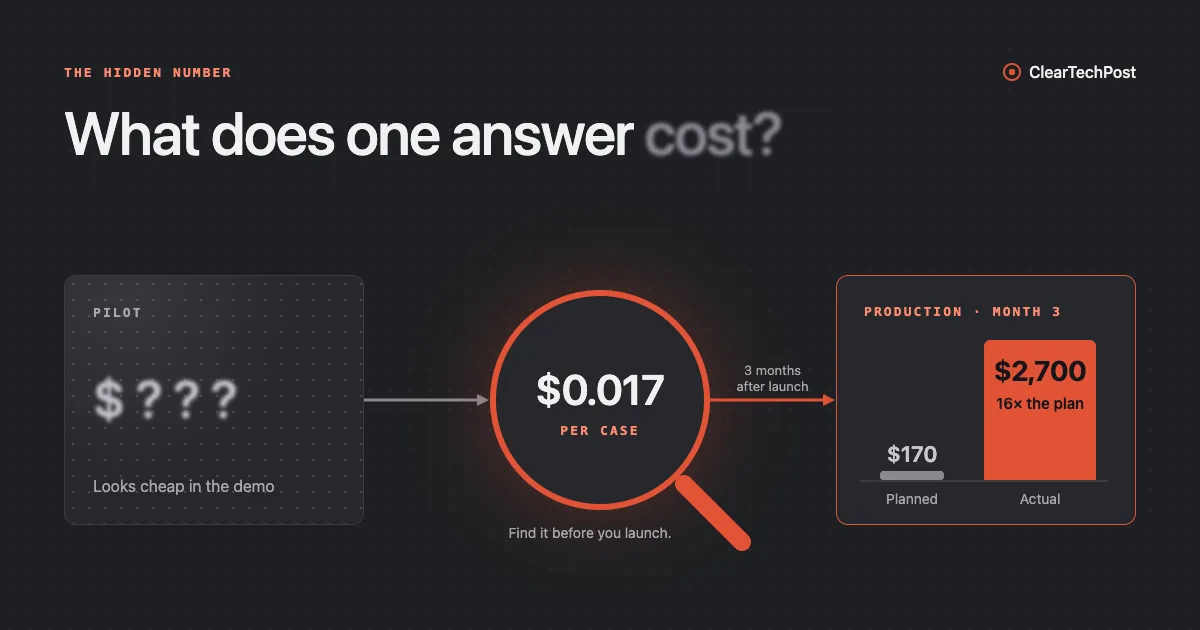
Your AI demo cost almost nothing. Then someone asks, “What will it cost to run for the whole company?” And nobody can answer.
I keep seeing this in pilots. The team knows the model works. They do not know the monthly bill. So finance says no, or approves a number that is wrong. A wrong number is worse than no number: it ends in a surprise invoice, or in a project that gets cut after launch.
The fix is a simple habit. Work out the cost per case before you build. This post shows how, in about 10 minutes, with one formula and one worked example.
Tokens in plain English
AI models do not read words. They read tokens, which are small pieces of text. A token is roughly three-quarters of an English word. You pay for every token that goes in and every token that comes out.
- Input tokens: everything you send. The question, your instructions, and any documents you attach.
- Output tokens: the answer the AI writes.
Prices are quoted per million tokens. On the current list prices I checked, output costs 5 times more than input for every model in the range.
Two things surprise people:
- The AI has no memory between calls. Each time, you send the full history and documents again, and you pay for them again.
- An agent makes many calls for one request. A chatbot answers in one call. An agent that plans, uses tools and checks its own work can make 10 to 20 calls for a single request, according to CloudZero.
Cost per case: one formula
A case is one unit of work your AI does: one customer question answered, one invoice read, one ticket summarised. Use the unit your business already counts.
The check takes three steps:
- Count the tokens in one case. Input and output. Every API response reports its token usage, so run 20 real cases and take the average.
- Multiply by the price. Input tokens times the input price, plus output tokens times the output price, divided by one million.
- Multiply by cases per month.
Worked example. A support assistant answers questions from your documents. Each case sends 6,000 input tokens (the question, the instructions, and the retrieved text) and gets 500 tokens back. You expect 10,000 cases a month. These are list prices from Anthropic’s pricing page, checked on 30 October 2026. Other vendors differ.
| Model | Input price ($ per M tokens) | Output price ($ per M tokens) | Cost per case ($) | Cost per month ($) |
|---|---|---|---|---|
| Haiku 5.5 | 0.10 | 0.50 | 0.00085 | 8.50 |
| Sonnet 5.5 | 2.00 | 10.00 | 0.017 | 170 |
| Opus 5.5 | 4.00 | 20.00 | 0.034 | 340 |
| Fable 5.1 | 10.00 | 50.00 | 0.085 | 850 |
Same job, and the bill is 100 times apart from the smallest model to the largest. Model choice is the biggest lever you have. But a cheaper model may answer worse. That is why you score the quality first, then pick the cheapest model that still passes.
Why the bill grows after launch
The pilot number is almost never the production number. Four things push it up:
- Agents multiply calls. Take the same assistant, but built as an agent that makes 12 calls per task and uses about 60,000 input and 15,000 output tokens in total (token counts from an illustrative example in the CloudZero guide). On Sonnet 5.5 that is $0.27 per task, or $2,700 a month for 10,000 tasks. That is about 16 times the simple version.
- Prompts creep up. Teams add instructions, examples and documents. If the input grows from 6,000 to 9,000 tokens, each case costs 35% more.
- Volume grows. Triple the cases and let the prompt creep, and the $170 bill becomes $690.
- Extra costs sit around the model. Retrieval, retries and monitoring all add tokens. One industry article puts these at 40% to 60% on top of the raw model bill, and says 73% of enterprises saw AI costs above plan, citing the FinOps Foundation. Both figures come from secondary sources, so use them as a rough warning, not as a budget (DataStorage).
So do the sum twice: once at today’s volume, and once at three times the volume with a longer prompt. If the second number is a surprise, better to learn it now.
Five ways to lower the cost
Numbers below use the same support assistant on Sonnet 5.5 ($170 a month).
- Use the smallest model that passes your test. Send easy questions to a small model and hard ones to a bigger one. If you assume 70% of cases go to Haiku, 20% to Sonnet and 10% to Opus, the bill falls to about $74 a month, 56% less. The split is my assumption: measure your own.
- Cache the part of the prompt that never changes. If 4,000 of the 6,000 input tokens are the same fixed instructions every time, cached reads cost $0.10 per million instead of $2. Cost per case drops from $0.017 to about $0.0094, 45% less. Caching works best with steady traffic, because the default cache lasts 5 minutes and the first write costs 1.25 times the normal input price.
- Send less. Trim chat history. Retrieve fewer, better documents. One industry guide says audits often find that 30% to 50% of input tokens add nothing to the answer (CloudZero).
- Batch the work that can wait. Reports, overnight scoring and bulk summaries can use the batch service, which is 50% cheaper on this vendor. The assistant would cost $85 a month if all of it could wait.
- Put a cap on every agent. Set a token limit per task. An agent that retries in a loop is the fastest way to a surprise invoice.
Every one of these can lower quality. Score your AI before and after each change. The check itself is cheap: at the published price of $0.042 per million input tokens for the Jev model behind JevEval, scoring 500 examples of about 2,000 tokens each costs about four cents. That is a vendor figure, and independent benchmarks are still to come.
Three things to do this month
- Pick one AI use case that is live or close to live. Run 20 real cases and write down the average input and output tokens.
- Work out cost per case and cost per month. Do it at today’s volume, and again at three times the volume.
- Put cost on your monthly check, next to the score. Two questions every month: is the score still passing, and what is it costing?
This is the fifth step of my playbook: run it, measure it, and improve it every month. If you want the full picture, start with why I focus on taking AI from pilot to production.
If you have a pilot and no clear number for what it will cost at scale, that is exactly what I help with. See Work with me.
Sources
Checked on 30 October 2026. Prices change often, so check the vendor page before you build a budget.
- Pricing, Claude Platform docs: model prices, caching and batch discounts.
- Your Guide To Inference Cost, CloudZero: agent call counts and wasted input tokens.
- AI Token Costs: What Enterprises Need to Budget For in 2026, DataStorage: overhead and budgeting figures, from secondary sources.
- Introducing JevEval, DeepEval: the $0.042 per million input tokens figure, a vendor claim.
The worked examples are my own calculations from the list prices above. They are illustrations, not quotes.