How to Know If Your AI Is Good Enough for Production?
How to Know If Your AI Is Good Enough for Production? A cheap, repeatable way to score your AI before release: what JevEval does, and what to check before you trust it.
Your AI demo looked great. Then someone asks, “Is it good enough to go live?” And nobody can answer.
I keep seeing this in pilots. The team has examples that work, a few that don’t, and a feeling. A feeling is not enough to put AI in front of customers, or in front of a regulator.
The fix is boring and powerful: test your AI like any other system. Give it a score. Run it on every change. A new tool called JevEval makes this cheaper and more repeatable. Here is what it does, and what to check before you trust it.
How most teams test AI today
Tests like this are called evals: tests that prove it works. Most teams run them in one of two ways.
- They read the answers by eye. This works for 10 examples. It breaks at 1,000.
- They ask another AI to grade. This is called “LLM-as-a-judge.” The judge writes a verdict in free text, like a teacher writing a comment on an essay.
The second way is better, but it has two problems. Every grade costs money, because a large model has to read and write. And the judge can change its mind: run the same test twice and the score can move. A test that moves is hard to trust before a release.
What JevEval does, in plain English
JevEval is a new add-on for DeepEval, a popular open-source tool for testing AI. It grades in a different way. It does not write a verdict. It answers questions that you write, and returns a probability for each one.
You do three things:
- Write the questions you care about. Each one is yes/no, a score on a scale, or pick-one.
- Let Jev answer them. Jev is a small “decision model” from TypeSafe AI. It returns probabilities, not paragraphs.
- Get one score. DeepEval combines the answers into a weighted score. Important questions can count double.
Take an AI that answers from your own documents (RAG). Two questions might be:
- Is the answer based on the documents it was given? (counts double)
- How well does it answer the question? (not at all, partly, fully)
You decide what “good” means. The tool then applies it in a far more repeatable way. DeepEval’s docs say no language model is used in the scoring: it is one request to Jev plus simple arithmetic.
The numbers, and the fine print
DeepEval’s announcement gives two figures:
- Price: $0.042 per million input tokens. Output is free.
- Speed: most checks finish in about 100 milliseconds.
These are vendor numbers. DeepEval says benchmarks against LLM-based judges will come later, so today you cannot tell how close the scores are to a human’s.
The fine print:
- It is early. The package is version 0.1.0.
- It is only as good as your questions. Vague questions give vague scores.
- It gives a score, not a reason in words. When you need the “why”, use an LLM judge.
- There is a size limit. Langfuse lists roughly 32,000 tokens per check.
- Access is controlled. You need a TypeSafe API key, and Langfuse notes a waitlist.
- Your test data goes to the provider. Read the terms before you use sensitive data.
The missing step between pilot and production
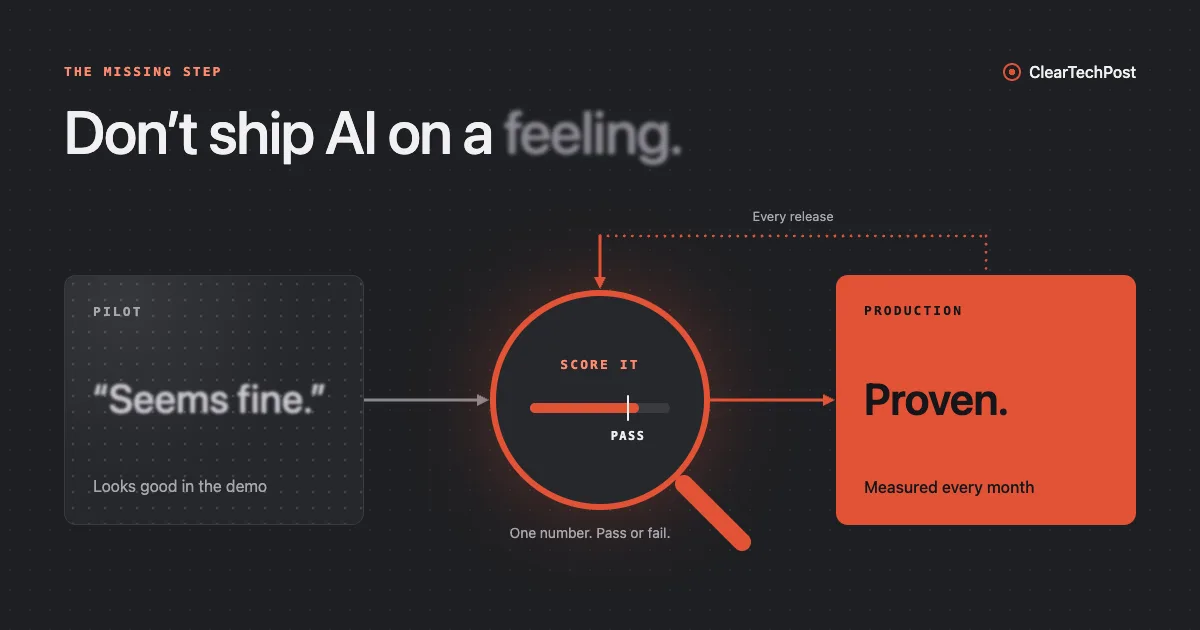
A pilot is ready for production when you can answer two questions with a number. Is it good enough today? Did the last change make it better or worse?
A cheap, repeatable score answers both. It also turns “I think it’s fine” into a pass-or-fail line you can put in a release checklist. This is what “measured” means when AI runs every month, not just on demo day.
Three things to do this month, with or without JevEval:
- Pick one AI use case that is live or close to live. Write 3 to 5 questions in plain words that define a good answer.
- Collect 50 real examples. Include some that failed.
- Score them two ways: by a person, and by your automated judge. If the two roughly agree, the cheap judge is good enough to run on every change. If they don’t, fix the questions first.
For engineers: try it in 10 minutes
Skip this section if you are not technical. You need a TypeSafe API key first, with DeepEval already installed:
pip install typesafe-sdk
export TYPESAFE_API_KEY=<your-key>
This example is from the JevEval README. It scores a RAG answer on two questions:
from deepeval.metrics import JevEval
from deepeval.metrics.jev_eval import Noul, Score

rag_quality = JevEval(
    name="RAG Answer Quality",
    evaluation_params=["input", "actual_output", "retrieval_context"],
    questions=[
        Noul("Is actual_output grounded in retrieval_context?", weight=2),
        Score("How well does actual_output answer input?",
              levels=["Does not answer", "Partially answers", "Fully answers"],
              weight=1),
    ],
)
Two gotchas from the docs. List Score levels worst first, because a best-first list silently flips your score. And Jev can only see the fields you list in evaluation_params. Full parameters are in the JevEval docs.
Where to go next
This post is part of one idea: AI that leaves the demo and earns its place in production. I explain why in Why I’m focusing on taking AI from pilot to production. Measuring is a big part of it.
Sources
Checked on 15 October 2026. JevEval is a new, early-stage product, so check the docs before you rely on any figure here.